

A CPAP blower is the component that defines the device. The mask, the humidifier, the display, and the firmware are the parts the user sees and touches, but the blower is the part that delivers the therapy, and the blower is the part that fails. A 2024 field-return study we reviewed across our own OEM customers showed that 60–70% of CPAP warranty returns were blower-related: bearing wear, impeller imbalance, motor driver failure, or acoustic deterioration above the published spec. The right blower chosen with the right spec is a 7-year field life; the wrong blower is a 24-month field return. The seven steps below are the protocol our team at Wonsmart uses to help OEM customers pick the right blower the first time.
This article is written for the procurement engineer, the design lead, and the regulatory affairs specialist at a respiratory device OEM that is specifying a CPAP blower for a new machine, a replacement platform, or a second-source qualification. The frameworks below draw on the CPAP blower product line at Wonsmart, where the 7 selection steps are the same checklist the engineering team runs for every OEM engagement. The same frameworks apply to any high-speed brushless DC centrifugal blower in a respiratory or similar medical-device application.
Why the Blower Choice Is the Single Most Important Spec
The blower is the part of a respiratory device that has to do the most work for the longest time, in the most demanding acoustic environment, with the least amount of power, while meeting a medical-device regulatory standard. A CPAP that runs 8 hours a night, 365 nights a year, for 5–7 years, has a blower that runs roughly 14,000–20,000 hours before the expected end-of-life. A consumer fan that runs 14,000–20,000 hours is a fan that is well past its design life; a medical blower that runs 14,000–20,000 hours is a blower that is just hitting the middle of its service life. The design margin is the difference between a consumer-grade brushless motor and a medical-grade brushless motor, and the difference is the seven steps below.
Three numbers define the blower’s job. First, the pressure, typically measured in cmH2O (centimeters of water column) for a CPAP or BiPAP application. A fixed-pressure CPAP runs at 4–20 cmH2O; an auto-CPAP runs at 4–20 cmH2O with a 0.5 cmH2O step; a BiPAP runs at 4–25 cmH2O on IPAP and 4–20 cmH2O on EPAP; a hospital ventilator runs at 5–40 cmH2O. The blower has to deliver the peak pressure at the rated flow with a 10–20% margin. Second, the flow, typically measured in L/min (liters per minute) for a CPAP or BiPAP, and in L/s for a high-flow or ventilator. A CPAP delivers 20–60 L/min at peak pressure; a BiPAP delivers 30–120 L/min; a high-flow nasal cannula delivers 20–80 L/min. Third, the noise, typically measured in dB(A) at 1 m. A modern CPAP is rated at 25–30 dB(A); a hospital ventilator is rated at 35–45 dB(A). The blower’s acoustic performance is the part of the spec the user hears every night, and a 5 dB(A) overshoot is a field complaint waiting to happen.
Because the three numbers interact, so the blower spec for a respiratory device is a single design choice, not three independent numbers. A blower that delivers the right pressure at the right flow is a blower that is too loud; a blower that is quiet enough is a blower that cannot deliver the peak pressure at the peak flow. The procurement team that asks for the three numbers separately is the procurement team that has a blower that fails on one of them in the field.
The 7-Step Selection Protocol
The seven steps below are the protocol the Wonsmart engineering team uses for every OEM engagement. The order is the order of dependency: step 1 sets the performance envelope, step 7 confirms the supplier is the right supplier. A procurement team that skips a step is a procurement team that has to redo the step in the field, typically at a 5–10× cost premium over doing the step correctly at the spec stage.
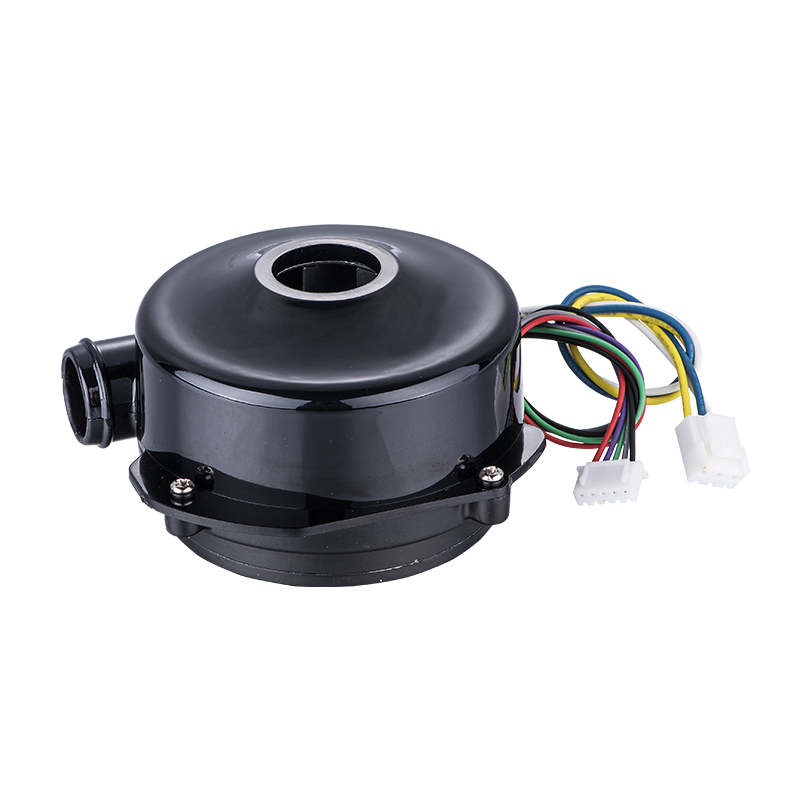
Step 1 — Pressure and Flow Targets
Specify the peak pressure, the peak flow, and the pressure-flow curve. A blower that delivers 20 cmH2O at 30 L/min is a different blower from a 20 cmH2O at 60 L/min, and a blower that delivers 20 cmH2O at 30 L/min at 0 back-pressure is a different blower from a 20 cmH2O at 30 L/min at the back-pressure of a 4-foot patient circuit. The pressure-flow curve is the spec; the single point on the curve is the marketing line. Ask the supplier for the published P-Q curve, with 5 or more points across the operating range, and confirm the curve in the OEM’s own test rig before signing off on the supplier.
Step 2 — Duty Cycle and Ramp Profile
A CPAP ramps from 4 cmH2O to the therapy pressure over 5–15 seconds, holds for 8 hours, and ramps down over 5–10 seconds. A BiPAP ramps between IPAP and EPAP every 3–5 seconds. A high-flow nasal cannula holds a constant flow with no ramp. A hospital ventilator has the most aggressive duty cycle: pressure and flow change continuously across the breath cycle, with the blower responding in 100–200 ms. The blower’s thermal management, motor driver, and bearing life all depend on the duty cycle. A blower specified for a fixed-pressure CPAP duty cycle is not the same blower specified for a BiPAP or ventilator duty cycle, and the supplier that does not ask for the duty cycle is a supplier that has not specified for the application.
Step 3 — Noise Budget
The noise budget is the part of the spec the user hears. A modern CPAP is rated at 25–30 dB(A) at 1 m at the therapy pressure; the user is 30–60 cm from the device on the bedside table. A 30 dB(A) blower is at the threshold of the user’s sleep; a 35 dB(A) blower is loud enough to wake the user’s partner. The noise budget has to be specified with the duty cycle (Step 2), because a blower that is 28 dB(A) at 4 cmH2O is often 35–40 dB(A) at 20 cmH2O. A supplier that publishes a single noise number without the duty cycle is a supplier that has not measured the worst case.
Step 4 — Form Factor and Integration
The blower has to fit inside the device enclosure, with the inlet and outlet on the right sides, with the right size of inlet and outlet for the device’s acoustic foam and silencing path, and with the right mounting pattern for the device’s mechanical frame. The form factor is the part of the spec that locks the device’s industrial design, and a blower that is 5 mm too tall is a blower that does not ship. The supplier that has 3–5 standard form factors (with published 3D models) is the supplier that fits the device without a 3-month mechanical redesign.
Step 5 — Electrical and EMC
The blower takes DC power (typically 12 V, 24 V, or 48 V, depending on the device architecture) and the motor driver has to meet the device’s EMC budget. A brushless DC centrifugal blower has a switching motor driver that runs at 20–50 kHz, and the switching harmonics are a real EMC concern. A blower that ships without a published EMC test report (EN 55011 / CISPR 11 for medical devices) is a blower that fails the device’s regulatory submission. The supplier that has the EMC test report in writing is the supplier that passes the 510(k) or CE-MDR submission on the first try.
Step 6 — IEC 60601-1 Compliance
IEC 60601-1 is the international standard for medical electrical equipment, and a CPAP is a Class IIa or Class IIb medical device under EU MDR 2017/745. The blower has to meet the patient-leakage-current, dielectric-strength, and insulation requirements of IEC 60601-1, and the supplier has to provide a documented compliance chain. A blower that is rated for industrial use (no patient contact, no medical isolation) is a different part from a blower that is rated for IEC 60601-1. A supplier that has the IEC 60601-1 declaration in writing is a supplier that ships to the medical market; a supplier that does not is a supplier that ships only to the industrial market.
Step 7 — Supplier Fit
The seventh step is the one that is often skipped: verify that the supplier is the right supplier for the program. Ask for the published datasheet, the EMC test report, the IEC 60601-1 declaration, the production lead time, the MOQ, the warranty, and a reference customer. A supplier that has all seven in 5–10 working days is a supplier that is ready to ship. A supplier that cannot answer one of them is a supplier that has not specified for a medical device.
Because the seven steps are interdependent, so the procurement team that walks through them in order is the procurement team that has a defensible spec sheet, a defensible regulatory chain, and a defensible field-life projection. The procurement team that walks through them out of order is the procurement team that has a blower that fails on the step it skipped.
What Goes Wrong: Three Common CPAP Blower Failures
Three failure modes account for the majority of CPAP field returns we see across our OEM customers. None of them are catastrophic; all three are preventable with a documented specification and a documented incoming-QC protocol.
- Bearing wear above the published life. The published bearing life is typically 20,000–30,000 hours at the rated load and the rated temperature. A bearing that runs 5°C above the rated temperature has a 30–50% shorter life; a bearing that runs in a contaminated inlet (a 4-foot patient circuit that the user does not clean) has a 50–80% shorter life. Prevention: specify the inlet filtration, the maximum ambient temperature, and the maximum back-pressure in writing; audit the bearing temperature on a sample of incoming blowers with a calibrated thermocouple.
- Impeller imbalance above the published spec. The impeller is balanced at the factory to a specific residual imbalance (typically G2.5 or G6.3 per ISO 1940). An impeller that is damaged in shipping or in field handling has a residual imbalance that drives bearing wear, acoustic noise, and motor driver fault. Prevention: specify the residual imbalance in writing; audit the acoustic noise on a sample of incoming blowers with a calibrated sound level meter at the rated pressure and flow.
- Motor driver failure above the rated duty cycle. The motor driver is rated for a specific duty cycle and a specific ambient temperature. A driver that runs 10°C above the rated ambient temperature has a 50–70% shorter life; a driver that runs at 110% of the rated duty cycle has a 40–60% shorter life. Prevention: specify the duty cycle, the ambient temperature, and the cooling strategy in writing; audit the driver temperature on a sample of incoming blowers with a calibrated thermal camera at the worst-case duty cycle.
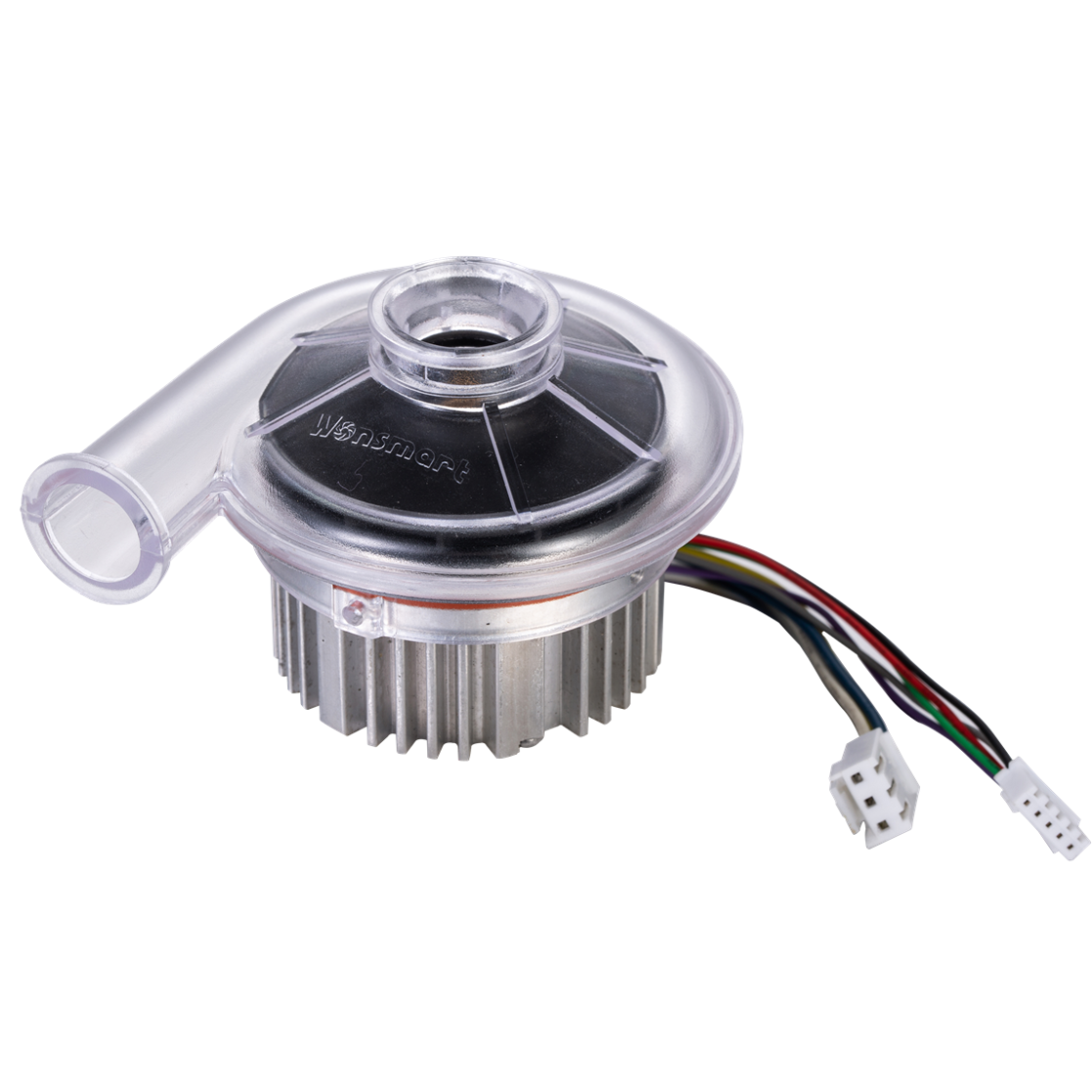
Procurement Checklist: Eight Questions to Ask the Blower Supplier
Eight questions, in order, that resolve the CPAP blower spec for a new device. Answer them in writing, attach the answers to the supplier brief, and use them as the incoming-QC checklist on receipt.
- What is the published pressure-flow curve? Ask for 5 or more points across the operating range. A single-point spec is a marketing spec, not a supplier spec.
- What is the published noise at the duty cycle? A 28 dB(A) at 4 cmH2O is not a 28 dB(A) at 20 cmH2O. The published noise has to be at the duty cycle, not at a single favourable point.
- What is the published service life at the duty cycle? 20,000–30,000 hours is the working default. A supplier that publishes a single number without the duty cycle is a supplier that has not measured the worst case.
- What is the form factor and the mounting pattern? 3D models (STEP) are the working default. A 2D drawing is not enough for an industrial design integration.
- What is the EMC test report? EN 55011 / CISPR 11 Class B for medical devices. A Class A report is an industrial spec, not a medical spec.
- What is the IEC 60601-1 declaration? A signed declaration with the test report. A “we can comply” statement is not a declaration.
- What is the production lead time at the OEM’s MOQ? A 12–16 week lead time is the working default for a 1,000–5,000 piece MOQ. A 4–6 week lead time is a sign the supplier is shipping from stock, not from production.
- What is the warranty? A 24-month warranty is the working default. A 12-month warranty is a sign the supplier is hedging on the life.
The eight questions above are the spec template any respiratory device OEM should be running against every CPAP blower quote. The supplier that answers all eight with a published datasheet, an EMC test report, an IEC 60601-1 declaration, and a documented production lead time is the supplier that ships on time. The supplier that cannot answer two of them is a trading company, and the OEM is better off walking away before the design lock.
Frequently Asked Questions
What is a CPAP blower?
A CPAP blower is the air-pumping component in a sleep apnea or respiratory therapy device. It is typically a DC brushless centrifugal blower with a high-speed permanent-magnet motor and a backward-curved impeller, designed to deliver 4–40 cmH2O at 20–120 L/min with 25–45 dB(A) acoustic noise and 20,000–30,000 hours service life. The blower is the most expensive and most failure-prone component in the device.
What is the difference between a DC brushless centrifugal blower and an AC induction blower?
A DC brushless centrifugal blower uses a permanent-magnet motor with an integrated electronic driver, runs on DC power (12 V, 24 V, or 48 V), and has 3–5× the life, 30–50% less noise, and 20–30% better efficiency than an AC induction blower. An AC induction blower runs on mains power, has a simpler driver, but is heavier, louder, and less efficient. The 2026 default for a medical CPAP blower is DC brushless.
What pressure does a CPAP blower need to deliver?
A fixed-pressure CPAP runs at 4–20 cmH2O; an auto-CPAP runs at 4–20 cmH2O with a 0.5 cmH2O step; a BiPAP runs at 4–25 cmH2O on IPAP and 4–20 cmH2O on EPAP; a hospital ventilator runs at 5–40 cmH2O. The blower has to deliver the peak pressure at the rated flow with a 10–20% margin.
What noise level is acceptable for a CPAP blower?
A modern CPAP is rated at 25–30 dB(A) at 1 m at the therapy pressure; the user is 30–60 cm from the device on the bedside table. A 30 dB(A) blower is at the threshold of the user’s sleep; a 35 dB(A) blower is loud enough to wake the user’s partner. The noise budget has to be specified at the duty cycle, not at a single favourable point.
How long does a CPAP blower last?
A medical-grade DC brushless centrifugal blower in a 5–7 year medical-device duty cycle has a design life of 20,000–30,000 hours. A CPAP that runs 8 hours a night, 365 nights a year, for 5–7 years, has a blower that runs roughly 14,000–20,000 hours before the expected end-of-life. A blower that fails before 14,000 hours is a field complaint; a blower that fails after 25,000 hours is past its design life.
What is IEC 60601-1 and why does it matter for a CPAP blower?
IEC 60601-1 is the international standard for medical electrical equipment, and a CPAP is a Class IIa or Class IIb medical device under EU MDR 2017/745. The blower has to meet the patient-leakage-current, dielectric-strength, and insulation requirements of IEC 60601-1, and the supplier has to provide a documented compliance chain. A blower that is not IEC 60601-1 compliant is a blower that cannot ship to the medical market.
Can a CPAP blower be used in a BiPAP or ventilator device?
Not without re-spec. A BiPAP blower’s duty cycle is faster (3–5 second ramp between IPAP and EPAP) and a ventilator blower’s duty cycle is the most aggressive (100–200 ms response to breath-cycle changes). A blower specified for a fixed-pressure CPAP duty cycle is not the same blower specified for a BiPAP or ventilator duty cycle, and the supplier has to re-spec the duty cycle, the bearing life, and the motor driver to match the new application.
How do I verify a CPAP blower supplier’s IEC 60601-1 claim?
Request a signed IEC 60601-1 declaration with the test report (typically from an accredited lab like TUV, Intertek, or UL). A supplier that has the declaration in 5–10 working days is a supplier that has the documentation practices that a medical-device program requires. A supplier that needs more than 2 weeks is a supplier that is sourcing the part from a third party and does not have direct control of the compliance chain.
Where to Go From Here
If you are specifying a CPAP blower for a new device, the next step is to share the eight-question procurement checklist with the supplier and request a written response with the published pressure-flow curve, the EMC test report, and the IEC 60601-1 declaration. The CPAP blower product line shows the form factors and the published pressure-flow curves supported by the Wonsmart program. The DC brushless centrifugal blower for CPAP product page has the technical datasheet, the EMC test report, and the IEC 60601-1 declaration for the standard CPAP blower formats. For a custom pressure-flow curve, a custom form factor, or a custom compliance chain, the Wonsmart engineering team can quote a custom blower in 5–10 working days from a confirmed spec.
Send the eight-question procurement checklist to your shortlist and request a published pressure-flow curve, an EMC test report, and a signed IEC 60601-1 declaration. A serious supplier answers all eight in 5–10 working days; a trading company cannot answer two of them. The Wonsmart engineering team is the entry point for the application-support conversation.
Post time: Oct-15-2026


