


Key Takeaways
- A blower swap is an interface decision, not a purchasing decision: match voltage, controller type, airflow, static pressure, unit size and rotation before you order.
- The WS8045-24-X200 is a 24 vdc brushless DC centrifugal unit with an external controller and a D80 mm by H45 mm housing.
- The published flow and pressure figures differ: the table gives 47 m3/h and 15.7 kPa, the performance note gives 39 m3/h at 0 kPa and 12.7 kPa.
- Send the failed unit’s nameplate data and drawing when you request a quote, because the published pages carry no pinouts or flange dimensions.
- A 12 vdc or 48 vdc unit is never a drop-in for a 24 vdc machine, whatever the flow rating suggests.
When the WS8045-24-X200 Is a Valid Replacement
The WS8045-24-X200 is a valid replacement only when the machine already runs a 24 vdc brushless DC centrifugal blower with an external controller and a duty point inside the published envelope. If any of those conditions fails, the part is a different machine rather than a spare, and the mismatch shows up as an under-inflated mattress, a tripped driver or reversed airflow.
The current air cushion machine blower catalog lists seven models here, and only one is 24 vdc: the WS8045-24-X200. The rest are 12 vdc mini centrifugal units, 48 vdc ring blowers and a 48 vdc 15,000 rpm high-speed mini blower.
The company reports that it was founded in 2009 and is certificated to ISO9001 and ISO13485. That is background, not a compatibility argument: the nameplate on the failed unit identifies the interface, and the WS8045 24V centrifugal blower page holds the published figures.
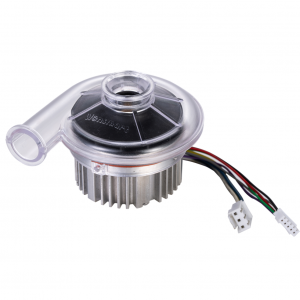
In the replacement requests I handle, the ones that stall arrive with a machine model and no nameplate photograph. My advice to a maintenance team is to send the label first and let the model follow from it.
The Compatibility Checklist: Nine Fields to Match Before You Order
Nine fields decide whether a replacement blower works, and they fail in a fixed order: three electrical fields, two pneumatic fields, then the enclosure and documentation fields. The first three take about a minute, because they are printed on the unit you are holding.
- Rated voltage. The published supply is 24 vdc with the controller external. A 12 vdc or 48 vdc unit is not a substitute at any flow rating, because the driver and windings are matched to the supply.
- Controller type. The WS8045-24-X200 needs an external controller board, and speed is set through 0-5 V or PWM. The WS4540-12-NZ01 has an internal controller, so the two do not interchange.
- Airflow at the duty point. Free-air flow is the wrong number to compare against a loaded bed, so the published airflow is a ceiling rather than a delivered value.
- Static pressure available. The blower must deliver pressure against the mattress fabric and the flow path, so pressure matters more than flow.
- Unit size and weight. The published size is D80 mm by H45 mm at a 500 g unit weight. A 1.5 kg 48 vdc ring blower needs a different envelope, so the size check often ends the enquiry first.
- Rotation direction. The published unit runs at CCW direction only, so a replacement spinning the other way moves air backwards through the manifold.
- Inlet protection and ambient temperature. The published guidance is to filter the inlet against dust and water and to keep the environmental temperature as low as possible. According to IEC 60529, enclosure protection is classified by an IP code covering solid objects and water ingress.
- Documentation scope. The published conformity papers cover a family and a list of models, so a replacement inherits the model it matches.
- Quantity and lead time. State the quantity needed at one time, because a single spare and a production batch are different order classes.
How to Read the Published Airflow and Static Pressure Figures
The airflow and static pressure on a blower product page have to be read as a pair, and on the WS8045-24-X200 the specification table and the performance note do not quote the same pair. The table lists an airflow of 47 m3/h and a static pressure of 15.7 kPa. The performance note states that the blower reaches a maximum 39 m3/h airflow at 0 kPa pressure and a maximum 12.7 kPa static pressure.
The two sets are not contradictory, but they are not interchangeable. One describes the unit at its rated catalogue condition, the other the free-air end of the published curve, where flow is highest and pressure is zero. Size the system on the table figures and the loaded machine sits on the curve, delivering less flow.
The lifetime figure needs the same treatment, because the two published conditions are not the same condition. The table states an MTTF above 20,000 hours under 25 degrees C, while the performance note states more than 20,000 hours at 20 degrees C. That is the difference between a part specified for a warm enclosure and a part for a cool one.
Comparing the 12 V, 24 V and 48 V Alternatives
The published range gives four usable voltage classes, and each carries a different pneumatic ceiling, so these are shortlist filters rather than a drop-in table.
- 12 vdc, low pressure. The WS4540-12-NZ01 is published at 8 m3/h and 4.8 kPa, with a 63 g unit weight and an internal controller, and its page lists air cushion machine use. It reaches maximum output air power at 3 kPa resistance and maximum efficiency at 3.5 kPa.
- 12 vdc, higher flow. The WS7040AL-12-X200 is published at 19 m3/h and 5.5 kPa across a 28.8-54 W power level, with a maximum speed of 42,500 rpm.
- 24 vdc, plastic housing. The WS9290B-24-220-X300 is published at 38 m3/h and 13 kPa, with a 490 g unit weight, an external controller and a D90 mm by L114 mm size, and it is listed as covered on the ETL authorization.
- 48 vdc, high pressure. The WS145110-48-150-X300 is published at 33 m3/h and 32 kPa with a 1.5 kg unit weight and a D110 mm by H107 mm size, reaching maximum output air power at 18 kPa.
- 48 vdc, high speed. The WS145120-48-170-S200 is published at 92 m3/h and 40 kPa, with speeds from 13,000 to 15,000 rpm and a current of 8.5 A to 35 A, which is a supply and cooling question as much as a pneumatic one.
Choose the 24 vdc WS8045-24-X200 when the failed unit was already 24 vdc with an external controller, because matching an existing supply avoids a driver, wiring and protection redesign. When a customer asks me for the closest equivalent, I start with the controller arrangement rather than the flow figure, because flow is the one number that can be recovered later.
Fitting the Replacement: Installation and First Run
The published operating guidance for this blower is short enough to follow in full, and every line of it belongs in the installation instruction. The unit runs at CCW direction only, and reversing the impeller does not change the air direction. A filter belongs on the inlet against dust and water, and the environmental temperature should be kept as low as possible to make the blower lifetime longer.
The controller side matters as much as the mechanical side. The published controller functions include speed regulation, speed pulse output, fast acceleration and braking, and the driver provides over current, under and over voltage and stall protection. In my experience the commissioning time goes into the controller settings rather than the refit, because a swapped blower with untouched drive parameters will not hold the bed pressure.
A commissioning record built from four measured values is what makes the next replacement a lookup instead of an investigation. I ask the technician to confirm rotation at low duty before connecting the load, confirm the inlet filter is fitted, record airflow and static pressure at the working point rather than at free air, and log the ambient temperature alongside those readings. On the safety side, the machine’s electrical equipment follows IEC 60204-1 for electrical safety of machinery, and a blower inside a medical device brings IEC 60601-1 into the file.
What the Published Certificates Prove and What They Do Not
A published conformity attestation supports a conformity assessment for the product family, and it does not by itself place a CE marking on the unit a customer receives. The published attestation carries the number E8A 004757 0002 Rev. 00, dated 2022-04-07, names Ningbo Wonsmart Motor Fan Co., Ltd as the holder, covers blowers, brushless dc blowers, motors and drivers, and is issued on a voluntary basis according to the electromagnetic compatibility Directive 2014/30/EU.
The useful part is its closing statement. After preparation of the technical documentation and the EU Declaration of conformity, the required CE marking can be affixed, that Declaration is issued under the manufacturer’s sole responsibility, and other relevant EU directives still have to be observed. I keep those documents apart, because the certificate supports the technical file while the declaration is what we sign.
The ETL authorization needs different attention, because it is model specific and the WS8045 is not on the list. It carries Control Number 5011624 and report number 180400582HZH-001, issued 26-Apr-2023, against UL 507:2017 and CSA C22.2 No.113:2018, and it lists six models including WS9290B-24-220-X300. The WS8045-24-X200 is not among them, so it should not be described as ETL covered. The published RoHS and REACH documents are test reports for a system model list that does include the WS8045 series, with an SVHC result below 0.1% by weight.
How to Request an Accurate Replacement Quote
The fastest route to a correct part is to send the failed unit’s identification data, because a model number on its own does not describe the interface. I ask for six things before a quotation is raised, and I would not approve an order without them.
- The nameplate of the failed unit. Model number, rated voltage, photographed rather than transcribed.
- The mechanical envelope. The drawing of the unit you removed, plus the port arrangement and the lead length.
- The electrical interface. The number of wires, the connector part number, and the existing controller board model with its speed command method.
- The duty point. The airflow and static pressure the machine needs at the bed or load, and the operating values you have measured.
- The installation conditions. Ambient temperature range, whether the inlet is filtered, and the enclosure ingress designators.
- The destination market and the file you need. Where the machine ships, and which conformity documents have to travel with the spare.
A request carrying only the machine model comes back as a list of candidates rather than a part number, and that is the most common reason a maintenance team orders the wrong blower. Once the six items above are in hand you can get a replacement quote that names the part, the controller arrangement and the documentation set.
The Maintenance Log That Makes the Next Swap Faster
Six log fields turn the next replacement from a guess into a lookup, and none of them are published on a product page. Record the blower model number and installation date, the controller board part number and speed command method, the inlet filter part number and service interval, the running hours, the ambient temperature at the last service, and the measured airflow and static pressure at the working point. In my own service log template these are the six fields that have removed a repeat failure.
Frequently Asked Questions
Q1: Can the WS8045-24-X200 replace a 12 vdc blower in an air cushion machine?
Q2: Why does the same product page publish both 47 m3/h at 15.7 kPa and 39 m3/h at 12.7 kPa?
Q3: Does the WS8045-24-X200 need its own controller board?
Q4: Can the replacement blower run in the opposite direction?
Q5: Is the WS8045-24-X200 covered by the ETL listing published on the certificate page?
Q6: What do I need to send to get an accurate replacement quote?
Post time: Oct-29-2026


